
The order kids learn to sort in
For kids, sorting means putting together things that have something in common. It looks like tidying up, but it is one of the first logic games. It usually comes in three steps.
- Same with same. The child sorts by what they see: red blocks with red blocks, small balls with small balls.
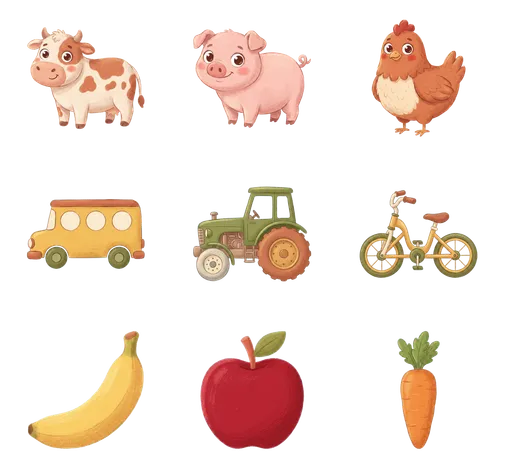
- Same kind. A cow and a hen don’t look alike, but they go together because they are animals. Now the group has a name, and that is already a category.
- Same use. An umbrella and rain boots go together because they are for the rain. The child no longer looks at how things look, but thinks about what they are for.
Each step can take months. A child who sorts by color but not yet by kind is right on track.
Which groups come first
Categories are easiest to start with two groups that are very different: balls and books, fish and birds. Wider groups come next, like animals and vehicles, or clothes and toys. Last come properties that cut across kinds: what flies and what swims, what is hot and what is cold.
A good check is the game “Which one doesn’t belong?”: three things of the same kind and one that is different, and the question which one is the odd one out.
Logic games at home
- Tidying up. Blocks in one box, toy cars in another. Two boxes are enough to start.
- Laundry. Socks in one pile, shirts in another. Then finding the pairs of socks.
- The cutlery drawer. Spoons with spoons, forks with forks. The child helps and sorts along the way.
- Groceries. Unpacking the shopping bag at home. What is fruit? What is a vegetable? What goes in the fridge?
- Which one doesn’t belong. Three spoons and a toy car on the table. “Why doesn’t it belong?” is the interesting question, because the answer often surprises.
- The child’s rule. A pile of toys, and the child decides how to sort them. Then the grown-up guesses the rule.
- Colors and shapes. Sorting by color or by shape is a good first step because the difference is easy to see.
- Counting. Once the piles are made, counting them. Which pile is bigger, blocks or cars?
What doesn’t help
- Only one right answer. A child may put the rabbit next to the carrot because rabbits eat carrots. That is logic too. Asking why, and then showing one more way, teaches more than marking it wrong.
- Too many groups. Four boxes at once quickly become a mess. A new group fits once two feel easy.
- Quizzing. “What’s this? And where does it go?” quickly turns into a test. Saying it in passing works differently: “These are all animals.”
- Correcting every mistake. Looking at the pile together and asking “Does this belong here?” is enough.
When mistakes are normal
Many two-year-olds sort things by how they look. At three, kids often start sorting by kind, if the groups are familiar and very different. Between four and five, many can also sort by use and say why something doesn’t belong.
Changing the rule in the middle of the game is common too. A child starts by color and ends by size. They often sort correctly but can’t explain why. That is a normal part of learning.
If something about your child’s development worries you for a long time, a pediatrician is the right person to ask. Every child goes at their own pace.
How Wise Beaks teaches sorting
In Wise Beaks, sorting is one of ten skills. It comes up in the mixed game, and the home screen also has its own tile for practicing just this skill. At two, a child gets only a few easy tasks; from three, there is much more to choose from.
Tasks are short and always start with a spoken instruction. The child drags pictures into two groups with questions like “Animals or vehicles?”. Other tasks ask them to find everything you can eat, match “Who eats what?”, or answer “Which one doesn’t belong?”.
The difficulty follows the child. Easier tasks ask “Balls or books?”, the next “Kitchen or bathroom?”, and the hardest “Flies or swims?” and “Hot or cold?”. When a child gets stuck, a hand shows what to do, and the voice says “Hmm, try another spot.”. A wrong answer has no penalty; the task simply goes on.
Every instruction is spoken by a real person, so a child who can’t read yet can play alone.