
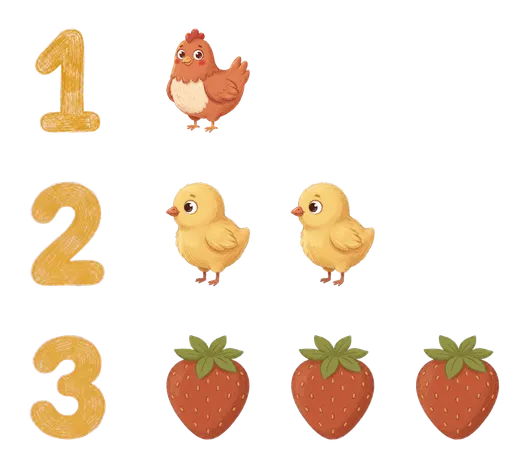
The order kids learn to count in
Counting starts as a song and only later becomes counting things. Behind the one word “counting” are three different skills, and they come one at a time.
- The counting song. The child says “one, two, three” like a rhyme. They learn the order of the words by heart, and sometimes skip a number.
- One at a time. The child touches one thing after another and says one number for each. Hand and word have to move together, and that takes practice.
- How many. The child understands that the last number said tells how many there are. Asked “How many apples?”, they no longer count again from the start, they say “three”.
The third step is the important one, and it usually comes much later than the first. A child who can say the numbers to ten may not yet be able to hand over three candies. That is normal.
Which numbers come first

One, two and three come first. Over time a child sees that many things at a glance, without counting, so the word connects easily to the amount. Four and five come next. Ten comes once five is solid.
For little kids, numbers are amounts first and symbols second. Once a child knows what “three” means, it is easy to show what the numeral 3 looks like. The other way round is harder: a child can recognize the numeral like a little picture without knowing how many things it stands for.
Counting games at home
- Stairs. Counting the steps on the way home or to the playground, one step, one number. The body helps keep the rhythm.
- At the table. Two forks, three apple slices. Putting things on the table and counting them out loud.
- Give me two. “Can you hand me two socks?” or “three blocks?”. This game practices the third step better than any reciting.
- Fingers and rhymes. Counting rhymes and fingers are always at hand, in the car and in the waiting room.
- Dice. Dice games teach kids to see the dots at a glance. One die and a playing piece on a drawn path are enough.
- Walks. Outside, one color and counting: how many red cars on the way to the store?
- Shapes. Counting the corners together: a triangle has three, a square four.
- Worksheet. After the find everything red sheet, counting the circled things.
What doesn’t help
- Reciting to show off. “Count to ten for Grandma” sounds nice, but it only shows the first step. Counting real things, even just to three, practices more.
- Numerals before amounts. Flash cards with numerals on their own teach a child to recognize a symbol. Things next to the numeral show what it means.
- Counting without touching. At first, touching or moving each thing means none is skipped and none is counted twice.
- Quizzing. “How many is this? And this?” quickly turns into a test. Counting in passing works differently: “Here we go, two spoons.”
- Correcting every mistake. Counting again together, slowly, is enough.
When mistakes are normal
A skipped number, the same thing counted twice and “five” as the answer to every “how many” are a normal part of learning. Kids get there at different speeds.
Many three-year-olds know one and two for sure and are working on three. Between three and five, most understand what the last number said means. Around five, many count to ten and recognize some numerals up to five.
If something about your child’s development worries you for a long time, a pediatrician is the right person to ask. Learning to count more slowly is not a reason to worry on its own.
How Wise Beaks teaches counting
In Wise Beaks, counting is one of ten skills, and it opens at age three. Until then, the home games in this guide do the job. Counting comes up in the mixed game, and the home screen also has its own tile for practicing just this skill.
Tasks are short and always start with a spoken instruction, for example “How many are there? Count them!”. The child touches the things one at a time, and every touch leaves a mark and a short sound, so it is easy to see what has been counted. Then they pick the right card. Other tasks ask the child to touch exactly two dogs, match the same amount, or find the missing number.
The difficulty follows the child. The first tasks have up to three things, the next up to five, and the hardest up to six. When a child gets stuck, a hand shows what to do, and the voice says “Count slowly. One at a time.”. A wrong answer has no penalty; the task simply goes on.
Every instruction is spoken by a real person, so a child who can’t read yet can play alone.